
Industry:HR Compliance Added By:Admin Posted On:Nov. 24, 2026
Key points
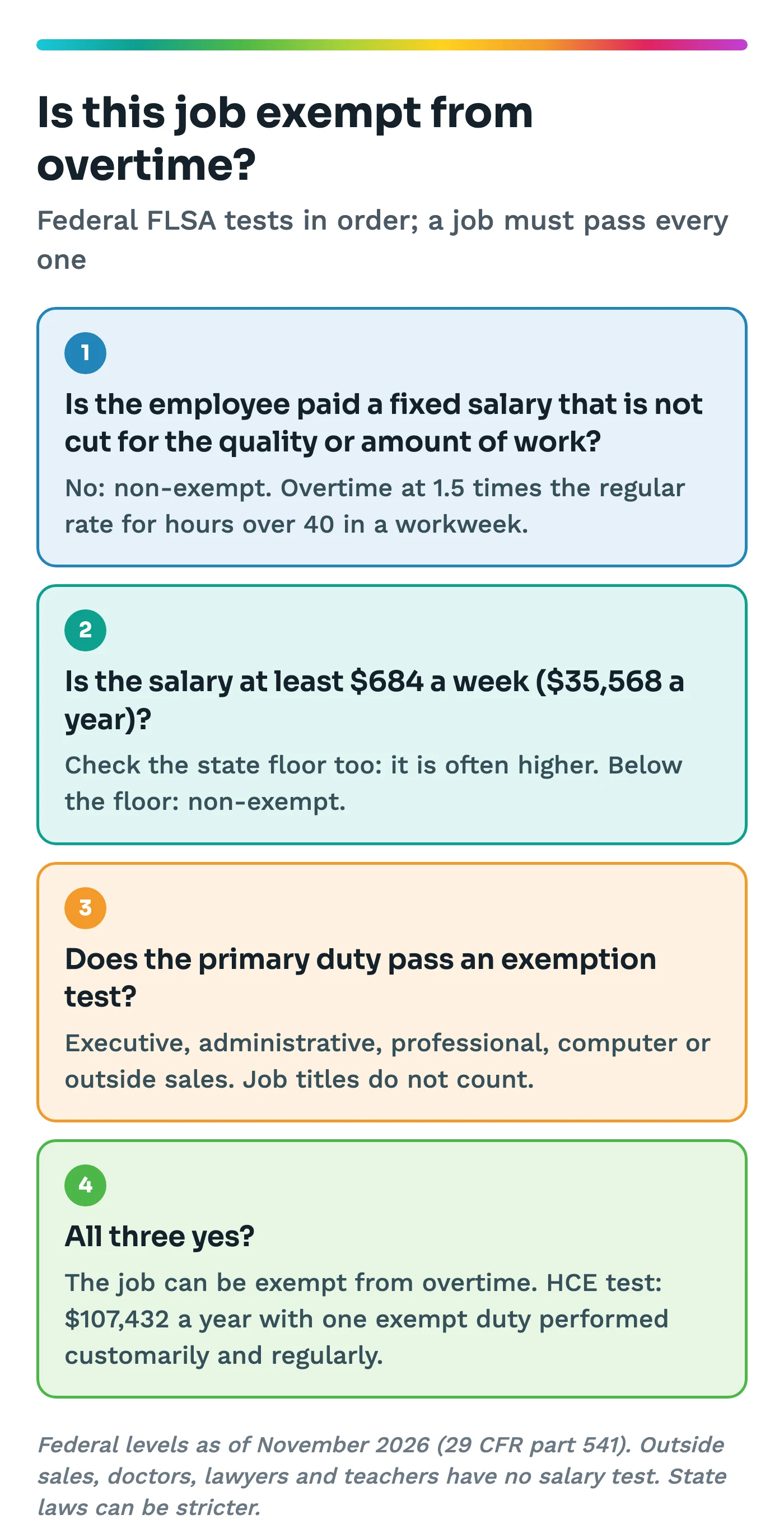
Exempt vs non-exempt decides who gets overtime. Under the Fair Labor Standards Act (FLSA), a non-exempt employee must get at least the $7.25 federal minimum wage and, as a general rule, time and a half for hours over 40 in a workweek. An exempt employee does not, but most exempt jobs must pass the salary basis, salary level and duties tests, and as of November 2026 the federal salary level is $684 a week ($35,568 a year), the level that has applied since a federal court vacated the 2024 increase in November 2024. Several states set much higher floors.
“Exempt” means exempt from the FLSA’s minimum wage and overtime rules under section 13(a)(1), the white-collar exemptions defined in 29 CFR Part 541. “Non-exempt” means the employee is covered by both. Status belongs to the job and the way it is paid, not to a title or an offer letter, and non-exempt is the default: the employer has to show that an exemption applies. The overtime rule in the table is the ordinary workweek case: under FLSA section 7(j), hospitals and residential care facilities can agree with employees to pay overtime after 8 hours in a day and 80 hours in a 14-day period, and under section 7(k) public fire and police agencies can use work periods of 7 to 28 days.
| Question | Exempt employee | Non-exempt employee |
|---|---|---|
| Overtime for hours over 40 in a workweek? | Not required by the FLSA | At least 1.5 times the regular rate in the ordinary workweek case (special work periods under sections 7(j) and 7(k)) |
| Minimum wage? | Not required by the FLSA, but most exempt jobs must meet the salary level | At least $7.25 an hour, or the higher state or local rate |
| How pay works | Usually a fixed salary of at least $684 a week; some exceptions for computer, outside sales, medical, legal and teaching jobs | Hourly, salary, piece rate or commission |
| Pay deductions | Only for the reasons listed in 29 CFR 541.602(b) | Pay can reflect hours actually worked |
| Hours records | The FLSA does not require daily hours records | Hours worked each workday and workweek must be recorded |
| Tests to pass | Salary basis, salary level and duties | None |
Payroll uses “exempt” in two unrelated ways. FLSA exempt status is about overtime. An employee who claims exemption on Form W-4 is claiming exemption from federal income tax withholding, which has nothing to do with the FLSA and must be renewed each year. The year-end payroll checklist covers the W-4 renewal deadline along with the other January tasks.
Yes. As of November 2026, the standard salary level for the executive, administrative and professional exemptions is $684 a week, equal to $35,568 a year, and the highly compensated employee (HCE) level is $107,432 a year. These are the 2019 overtime rule levels, first effective January 1, 2020, and in force again since November 15, 2024 (the $844 level applied from July 1 to November 15, 2024), and they are the figures on DOL’s salary levels page. Lower levels apply in Puerto Rico, Guam, the U.S. Virgin Islands and the Northern Mariana Islands ($455 a week) and American Samoa ($380 a week), and the motion picture industry has a special $1,043 weekly base rate.
DOL’s 2024 overtime rule raised the salary level to $844 a week on July 1, 2024, and was to raise it to $1,128 a week ($58,656 a year) on January 1, 2025, with the HCE level at $132,964, then $151,164. On November 15, 2024, the federal court in Texas v. U.S. Department of Labor (E.D. Tex.) vacated the rule, and a second Texas court did the same in Flint Avenue, LLC v. U.S. Department of Labor on December 30, 2024. The Fifth Circuit dismissed DOL’s appeals in May 2026. The $1,128 level never took effect, and $844 is no longer the law.
DOL has enforced $684 since the November 2024 court ruling. Once the appeals ended, it published a technical amendment, Federal Register document 2026-09839, on May 15, 2026, effective the same day. It removes the vacated 2024 text from Part 541 and puts back the text that applied before, including the $684, $107,432 and $27.63 levels. DOL skipped notice and comment because the change only conforms the regulations to the court judgments. The amendment does not set a new threshold.
Not yet. As of November 2026, DOL has not proposed a new salary level, though the May 2026 amendment says it may update Part 541 later through notice-and-comment rulemaking. Any increase would need a proposal, a comment period and a final rule, so employers would get warning.
Paying a salary does not make a job exempt. A salaried non-exempt employee is still owed overtime because the job fails the duties test or the salary is too low. An exempt salary must also be paid on a salary basis under 29 CFR 541.602: a predetermined amount each pay period, paid weekly or less often, that is not cut because of the quality or quantity of the work.
An exempt employee gets the full salary for any week in which they do any work, whatever the days or hours worked; no pay is due for a week with no work. If the employer closes because work is not available, it cannot deduct that time from an exempt employee who was ready, willing and able to work.
Section 541.602(b) allows deductions only for:
Nondiscretionary bonuses, incentives and commissions paid annually or more often can cover up to 10% of the standard salary level. This does not apply to the HCE level or to state salary floors such as California’s. If the total falls short at the end of a 52-week period, one catch-up payment is allowed by the next pay period, counting only toward the prior year.
Under 29 CFR 541.603, an actual practice of improper deductions costs the exemption during that period for employees in the same job classification working for the managers responsible. Isolated or inadvertent deductions do not, if reimbursed. The safe harbor protects employers with a clearly communicated policy and complaint procedure that reimburse improper deductions and commit to comply, unless they keep deducting after complaints.
Most duties tests turn on the employee’s primary duty: the principal, main or most important duty. Under 29 CFR 541.700, an employee who spends more than half their time on exempt work will generally meet that requirement, but time is not the only test. DOL’s Fact Sheet #17A summarizes the tests, and it is explicit that job titles do not decide exempt status.
| Exemption | Federal pay test | Duties test in brief | Regulation |
|---|---|---|---|
| Executive | Salary of $684 a week | Primary duty is managing the enterprise or a recognized department or subdivision; regularly directs two or more full-time employees or the equivalent; can hire or fire, or their recommendations get particular weight | 29 CFR 541.100 |
| Administrative | Salary or fee of $684 a week | Primary duty is office or non-manual work directly related to the management or general business operations of the employer or its customers, and includes discretion and independent judgment on matters of significance | 29 CFR 541.200 |
| Learned professional | Salary or fee of $684 a week (none for doctors, lawyers, teachers) | Work requiring advanced knowledge in a field of science or learning, usually gained through a prolonged course of specialized intellectual instruction | 29 CFR 541.301 |
| Creative professional | Salary or fee of $684 a week | Work requiring invention, imagination, originality or talent in a recognized artistic or creative field | 29 CFR 541.302 |
| Computer employee | $684 a week salary, or $27.63 an hour | Systems analyst, programmer, software engineer or similarly skilled worker doing systems analysis or the design, development, testing or modification of systems or programs | 29 CFR 541.400 |
| Outside sales | None | Primary duty is making sales or obtaining orders or contracts, and the employee is customarily and regularly away from the employer’s place of business | 29 CFR 541.500 |
| Highly compensated employee | $107,432 total a year, including $684 a week in salary or fees | Customarily and regularly performs at least one exempt executive, administrative or professional duty; office or non-manual work only | 29 CFR 541.601 |
The administrative exemption needs the closest look: discretion and independent judgment means weighing options and deciding on matters that affect the business, not applying set procedures well. Under 29 CFR 541.301, registered nurses generally qualify as learned professionals, while licensed practical nurses and most paralegals generally do not.
The HCE test in 29 CFR 541.601 trades a lighter duties test for higher pay. An employee with total annual compensation of at least $107,432, including at least $684 a week on a salary or fee basis, is exempt if they customarily and regularly perform any one exempt executive, administrative or professional duty.
State law may not follow the HCE test. California has no HCE exemption, so California employees must pass the state’s full duties test and salary level.
Section 18 of the FLSA keeps higher state standards in force, so an employer must meet both the federal test and the test of the state where the employee works. Many state salary levels are a multiple of the state minimum wage, so they rise when the rate does; the minimum wage by state table lists the January 1, 2027 increases behind them. The figures below were checked against state sources in November 2026.
| Jurisdiction | 2026 minimum salary | 2027 minimum salary | How it is set |
|---|---|---|---|
| Federal (FLSA) | $684 a week ($35,568 a year) | $684 a week unless DOL issues a new final rule | Fixed in 29 CFR 541.600 |
| California | $1,352 a week ($70,304 a year) | $1,392 a week ($72,384 a year) from January 1 | 2 × state minimum wage × 2,080 hours |
| Washington, 51+ employees | $1,541.70 a week ($80,168.40 a year) | $1,773.00 a week ($92,196.00 a year) from January 1 | 2.5 × state minimum wage × 40 hours in 2027 |
| Washington, 1–50 employees | $1,541.70 a week ($80,168.40 a year) | $1,595.70 a week ($82,976.40 a year) from January 1 | 2.25 × state minimum wage × 40 hours in 2027 |
| New York City, Long Island, Westchester | $1,275.00 a week ($66,300 a year) | Not yet published; the minimum wage stays at $17.00 on January 1, and a proposed rise to $17.60 from March 1, 2027 needs legislative approval | Executive and administrative jobs; moves with the minimum wage |
| Rest of New York | $1,199.10 a week ($62,353.20 a year) | Not yet published; the minimum wage stays at $16.00 on January 1, and a proposed rise to $16.55 from March 1, 2027 needs legislative approval | Executive and administrative jobs; moves with the minimum wage |
| Colorado | $1,111.23 a week ($57,784 a year) | Set by CPI adjustment in the state’s annual order; check CDLE | COMPS Order and PAY CALC Order |
| Alaska | $1,120 a week (since July 1, 2026) | $1,200 a week from July 1, 2027 | 2 × state minimum wage for the first 40 hours |
| Maine | $45,300.32 a year ($871.16 a week) | $47,101.08 a year ($905.79 a week) from January 1 | More than 3,000 × state minimum wage |
California’s exempt salary floor is twice the state minimum wage for full-time work, so the $17.40 rate takes it to $72,384 on January 1, 2027. The duties test is stricter too: under Labor Code section 515, the employee must be “primarily” engaged in exempt work, which means more than half of their work time.
Washington is phasing its threshold up to 2.5 times the state minimum wage. Employers with 51 or more employees reach it on January 1, 2027, and smaller employers in 2028, according to the L&I salary threshold schedule. Computer professionals paid by the hour need at least $62.06 an hour in 2027. California’s computer software exemption requires $61.03 an hour from January 1, 2027 ($58.85 in 2026).
New York’s minimums cover executive and administrative employees and change in proportion to the minimum wage, which does not rise on January 1, 2027. The NYS DOL minimum wage FAQ lists the 2026 levels; check it for any 2027 notice before year-end.
Colorado adjusts its threshold for inflation each year, Alaska’s follows its July 1 minimum wage and Maine’s its January 1 rate. Remote employees count where they work, so a salary that is exempt in Texas can be too low for the same job done from Seattle.
Misclassification can surface through an employee complaint, a wage claim or a DOL investigation, and the cost is the overtime that should have been paid:
Classification also feeds other filings: properly exempt employees have no FLSA-required overtime to include in no tax on overtime W-2 reporting. The separate question of whether a worker is an employee at all is covered in independent contractor vs employee; DOL published a final independent contractor rule on November 23, 2026, effective January 22, 2027.
Run this review before the January 1, 2027 state changes:
For a full walk-through of the duties, salary level and salary basis tests, the six exemptions and overtime calculations, the live FLSA wage and hour compliance webinar runs on December 2, 2026. Other sessions are under HR compliance webinars, and the 247Compliance newsletter reports rule changes such as a new DOL salary proposal.
Non-exempt employees are covered by the FLSA’s minimum wage and overtime rules, so as a general rule they get time and a half for hours over 40 in a workweek (some hospital and public safety jobs use special work periods). Exempt employees are not owed overtime because their job meets an exemption, usually by paying a salary of at least $684 a week and passing a duties test.
The federal level is $684 a week, or $35,568 a year, and the highly compensated employee level is $107,432 a year. These levels have applied since courts vacated the 2024 increases to $844 and $1,128 in November 2024; DOL put them back into the regulations on May 15, 2026. States such as California, Washington, New York, Colorado, Alaska and Maine require more.
Either. A salary is only one part of the test. A salaried employee whose duties do not fit an exemption, or whose salary is below the federal or state level, is salaried non-exempt and must be paid overtime.
Most hourly employees are non-exempt. The main exception is computer employees paid at least $27.63 an hour who meet the computer duties test; state hourly floors are far higher, such as $61.03 in California and $62.06 in Washington in 2027. Licensed doctors and lawyers, teachers and outside sales employees who meet their duties tests have no salary requirement, so they can be exempt even when they are not paid a salary.
Generally no. Deductions are allowed for full-day personal absences, full-day sick absences under a bona fide plan, full-day disciplinary suspensions under a written policy, safety penalties, FMLA leave and the first and last weeks of employment. Partial-day docking for other reasons can cost the exemption.
No. The 2024 rule that would have set $1,128 a week from January 1, 2025 was vacated by a Texas federal court on November 15, 2024, and DOL removed it from the regulations in May 2026. As of November 2026 the federal level is $684 a week, and DOL has not proposed a new one.
Classify every job correctly before 2027
The live FLSA wage and hour webinar on December 2, 2026 covers the exemption tests, salary level and salary basis rules, recent changes to the salary thresholds and overtime calculations.
See the FLSA webinarThis article is general information, not legal or tax advice. Check the official sources above or consult a qualified advisor for your situation.